Filters
Question type

Study Flashcards

You are an analyst preparing a forecast of the effects of macroeconomic changes in the economy. What happens to prices and GDP when imported inputs become cheaper?


A) Both prices and GDP increase.
B) Both prices and GDP decrease.
C) Prices increase, and GDP decreases.
D) Prices decrease, and GDP increases.

E) B) and C)
F) A) and D)

Correct Answer

verifed

verified

When government expenditure rises by $250 million and the multiplier is 2, then ceteris paribus, GDP will eventually rise by:


A) $500 million.
B) $250 million.
C) $125 million.
D) $750 million.

E) A) and D)
F) None of the above

Correct Answer

verifed

verified

A

Ceteris paribus, a decrease in government expenditure leads to a:


A) right shift of the aggregate demand curve.
B) left shift of the aggregate demand curve.
C) movement up and to the left along the same aggregate demand curve.
D) movement down and to the right along the same aggregate demand curve.

E) All of the above
F) C) and D)

Correct Answer

verifed

verified

(Figure: Aggregate Supply) Use Figure: Aggregate Supply. If the economy is at point E, nominal wages will _____, and the short-run aggregate supply curve will shift _____ until actual output is _____ potential output. (Figure: Aggregate Supply)  Use Figure: Aggregate Supply. If the economy is at point E, nominal wages will _____, and the short-run aggregate supply curve will shift _____ until actual output is _____ potential output.   A) increase; left; equal to. B) increase; left; equal to C) increase; right; greater than D) increase; right; greater than. E) decrease; right; equal to F) decrease; right; equal to. G) decrease; right; less than. H) decrease; right; less than


A) increase; left; equal to.
B) increase; left; equal to
C) increase; right; greater than
D) increase; right; greater than.
E) decrease; right; equal to
F) decrease; right; equal to.
G) decrease; right; less than.
H) decrease; right; less than

I) A) and B)
J) B) and G)

Correct Answer

verifed

verified

The difference between total investment and planned investment is that:


A) planned investment is total investment minus taxes.
B) planned investment is always larger than total investment.
C) total investment includes changes in inventories.
D) planned investment includes changes in inventories.

E) None of the above
F) A) and B)

Correct Answer

verifed

verified

(Figure: Shift of the Aggregate Demand Curve) Use Figure: Shift of the Aggregate Demand Curve. A movement from point B on AD1 to point E on AD2 may result from: (Figure: Shift of the Aggregate Demand Curve)  Use Figure: Shift of the Aggregate Demand Curve. A movement from point B on AD1 to point E on AD2 may result from:   A) an increase in consumer optimism B) an increase in consumer optimism. C) an increase in consumer pessimism. D) an increase in consumer pessimism E) an increase in personal income taxes. F) an increase in personal income taxes G) the central bank reducing the quantity of money H) the central bank reducing the quantity of money.


A) an increase in consumer optimism
B) an increase in consumer optimism.
C) an increase in consumer pessimism.
D) an increase in consumer pessimism
E) an increase in personal income taxes.
F) an increase in personal income taxes
G) the central bank reducing the quantity of money
H) the central bank reducing the quantity of money.

I) B) and C)
J) B) and E)

Correct Answer

verifed

verified

Explain the international trade effect on net exports when prices rise in the economy.

Correct Answer

verifed

verified

An output-induced monetary policy response to lower interest rates causes a:


A) right shift of the aggregate supply curve.
B) left shift of the aggregate demand curve.
C) right shift of the aggregate demand curve.
D) movement along the same aggregate demand curve.

E) A) and B)
F) A) and C)

Correct Answer

verifed

verified

C

(Figure: Shift of the Aggregate Demand Curve) Use Figure: Shift of the Aggregate Demand Curve. A movement from point A on AD1 to point C on AD2 may result from a(n) : (Figure: Shift of the Aggregate Demand Curve)  Use Figure: Shift of the Aggregate Demand Curve. A movement from point A on AD1 to point C on AD2 may result from a(n) :   A) lower price level B) lower price level. C) higher price level D) higher price level. E) increase in aggregate spending. F) increase in aggregate spending G) significant decrease in consumers' income H) significant decrease in consumers' income.


A) lower price level
B) lower price level.
C) higher price level
D) higher price level.
E) increase in aggregate spending.
F) increase in aggregate spending
G) significant decrease in consumers' income
H) significant decrease in consumers' income.

I) B) and C)
J) G) and H)

Correct Answer

verifed

verified

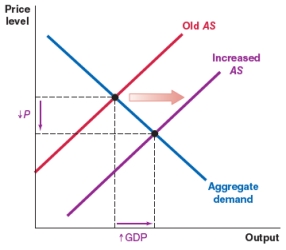
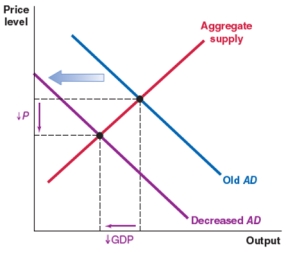
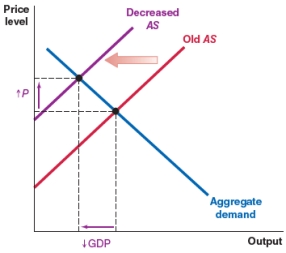
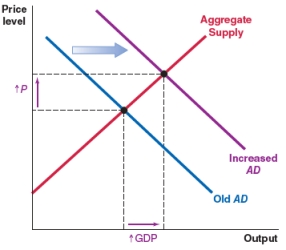
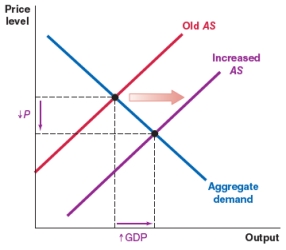
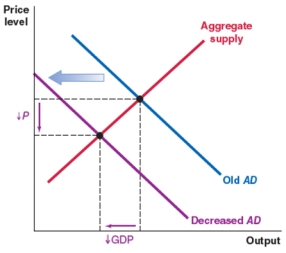
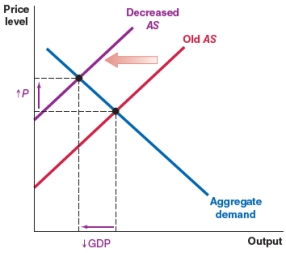
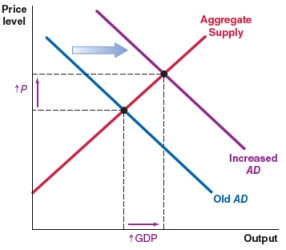
The stock market drops significantly. Ceteris paribus, which of the graphs shows the correct effect on the AD-AS framework?


A)
The stock market drops significantly. Ceteris paribus, which of the graphs shows the correct effect on the AD-AS framework? A)    B)    C)    D)
B)
The stock market drops significantly. Ceteris paribus, which of the graphs shows the correct effect on the AD-AS framework? A)    B)    C)    D)
C)
The stock market drops significantly. Ceteris paribus, which of the graphs shows the correct effect on the AD-AS framework? A)    B)    C)    D)
D)
The stock market drops significantly. Ceteris paribus, which of the graphs shows the correct effect on the AD-AS framework? A)    B)    C)    D)

E) A) and D)
F) A) and C)

Correct Answer

verifed

verified

Ceteris paribus, a decrease in imports leads to a:


A) movement up and to the left along the same aggregate demand curve.
B) movement down and to the right along the same aggregate demand curve.
C) right shift of the aggregate demand curve.
D) left shift of the aggregate demand curve.

E) All of the above
F) None of the above

Correct Answer

verifed

verified

C

How does a reduction in corporate tax rates affect the economy in the AD-AS framework? Draw a graph of the AD-AS framework to illustrate your answer.

Correct Answer

verifed

verified

How does a depreciation of the Kenyan shilling affect aggregate demand in Kenya in the AD-AS framework? Draw a graph of the AD-AS framework to illustrate your answer.

Correct Answer

verifed

verified

Which policy will shift the AD curve to the left?


A) an increase in government spending
B) an increase in government spending.
C) an increase in tax rates
D) an increase in tax rates.
E) an increase in the money supply.
F) an increase in the money supply
G) a decrease in tax rates.
H) a decrease in tax rates

I) B) and G)
J) All of the above

Correct Answer

verifed

verified

An increase in government spending, all things equal, will cause the aggregate demand curve to:


A) become positively sloped.
B) become positively sloped
C) remain constant
D) remain constant.
E) shift to the right
F) shift to the right.
G) shift to the left
H) shift to the left.

I) F) and G)
J) C) and G)

Correct Answer

verifed

verified

If declining labor union membership causes workers to lose bargaining power, resulting in lower wages, production costs will:


A) increase, and the SRAS curve will shift to the left, decreasing equilibrium GDP and the aggregate price level.
B) increase, and the SRAS curve will shift to the left, decreasing equilibrium GDP and the aggregate price level
C) fall, there will be a downward movement along the SRAS curve, equilibrium GDP will increase, and the aggregate price level will fall
D) fall, there will be a downward movement along the SRAS curve, equilibrium GDP will increase, and the aggregate price level will fall.
E) not change, and the AD curve will shift to the right, increasing equilibrium GDP and the aggregate price level
F) not change, and the AD curve will shift to the right, increasing equilibrium GDP and the aggregate price level.
G) fall, and the SRAS curve will shift to the right, increasing equilibrium GDP and lowering the aggregate price level.
H) fall, and the SRAS curve will shift to the right, increasing equilibrium GDP and lowering the aggregate price level

I) C) and F)
J) A) and B)

Correct Answer

verifed

verified

Create four graphs that illustrate the four stages of the adjustment of the aggregate supply curve from the very short run to long run when there is a negative aggregate demand shock.

Correct Answer

verifed

verified

How does the economy adjust from the short run to the long run when there is a negative demand side shock to the economy?

Correct Answer

verifed

verified

The short-run aggregate supply curve has a _____ slope, showing that increases in the price level will _____ the quantity of aggregate output supplied by firms.


A) positive: increase
B) positive: increase.
C) positive; decrease
D) positive; decrease.
E) negative; increase
F) negative; increase.
G) negative; decrease
H) negative; decrease.

I) B) and D)
J) E) and G)

Correct Answer

verifed

verified

Suppose that the Federal Reserve engages in contractionary monetary policy. Ceteris paribus, which of the graphs shows the correct effect in the AD-AS framework?


A)
Suppose that the Federal Reserve engages in contractionary monetary policy. Ceteris paribus, which of the graphs shows the correct effect in the AD-AS framework? A)    B)    C)    D)
B)
Suppose that the Federal Reserve engages in contractionary monetary policy. Ceteris paribus, which of the graphs shows the correct effect in the AD-AS framework? A)    B)    C)    D)
C)
Suppose that the Federal Reserve engages in contractionary monetary policy. Ceteris paribus, which of the graphs shows the correct effect in the AD-AS framework? A)    B)    C)    D)
D)
Suppose that the Federal Reserve engages in contractionary monetary policy. Ceteris paribus, which of the graphs shows the correct effect in the AD-AS framework? A)    B)    C)    D)

E) B) and D)
F) None of the above

Correct Answer

verifed

verified

Showing 1 - 20 of 169

Related Exams

Show Answer