Filters
Question type

Study Flashcards

For the circuit shown in the figure, R1 = 5.6 Ω, R2 = 5.6 Ω, R3 = 14 Ω, and ε = 6.0 V, and the battery is ideal. (a) What is the equivalent resistance across the battery? (b) Find the current through each resistor. For the circuit shown in the figure, R<sub>1</sub> = 5.6 Ω, R<sub>2</sub> = 5.6 Ω, R<sub>3</sub> = 14 Ω, and ε = 6.0 V, and the battery is ideal. (a) What is the equivalent resistance across the battery? (b) Find the current through each resistor.

Correct Answer

verifed

verified

(a) 9.6 Ω ...

View Answer

For the circuit shown in the figure, R1 = 18 Ω, R2 = 44 Ω, R3 = 33 Ω, R4 = 14 Ω, R5 = 12 Ω, V1 = 18 V, V2 = 12 V, and the batteries are ideal. Determine I1 and I2. For the circuit shown in the figure, R<sub>1</sub> = 18 Ω, R<sub>2</sub> = 44 Ω, R<sub>3</sub> = 33 Ω, R<sub>4</sub> = 14 Ω, R<sub>5</sub> = 12 Ω, V<sub>1 </sub>= 18<sub> </sub>V, V<sub>2</sub> = 12 V, and the batteries are ideal. Determine I<sub>1</sub> and I<sub>2</sub>.

Correct Answer

verifed

verified

I1 = 0.25 A...

View Answer

Two resistors in series are equivalent to 9.0 Ω, and in parallel they are equivalent to 2.0 Ω. What are the resistances of these two resistors?

Correct Answer

verifed

verified

A number of resistors are connected across points A and B as shown in the figure. What is the equivalent resistance between points A and B? A number of resistors are connected across points A and B as shown in the figure. What is the equivalent resistance between points A and B?   A)  4 Ω B)  6 Ω C)  8 Ω D)  10 Ω E)  12 Ω


A) 4 Ω
B) 6 Ω
C) 8 Ω
D) 10 Ω
E) 12 Ω

F) A) and E)
G) B) and C)

Correct Answer

verifed

verified

As more resistors are added in parallel across a constant voltage source, the power supplied by the source


A) increases.
B) decreases.
C) does not change.
D) increases for a time and then starts to decrease.

E) A) and B)
F) A) and C)

Correct Answer

verifed

verified

A

If emf of the ideal battery is V = 100 V, what is the potential difference across R5 for the circuit shown in the figure? If emf of the ideal battery is V = 100 V, what is the potential difference across R<sub>5</sub> for the circuit shown in the figure?   A)  19 V B)  40 V C)  75 V D)  77 V


A) 19 V
B) 40 V
C) 75 V
D) 77 V

E) A) and D)
F) C) and D)

Correct Answer

verifed

verified

Three capacitors of equal capacitance are arranged as shown in the figure, with a voltage source across the combination. If the voltage drop across C1 is 10.0 V10.0 \mathrm {~V} \text {, } what is the voltage drop across C3?C _ { 3 } ?  Three capacitors of equal capacitance are arranged as shown in the figure, with a voltage source across the combination. If the voltage drop across C<sub>1</sub> is  10.0 \mathrm {~V} \text {, }  what is the voltage drop across  C _ { 3 } ?    A)  20 V B)  10.0 V C)  40 V D)  30 V


A) 20 V
B) 10.0 V
C) 40 V
D) 30 V

E) C) and D)
F) B) and C)

Correct Answer

verifed

verified

Three resistors with resistances of 2.0 Ω, 6.0 Ω, and 12 Ω are connected across an ideal dc voltage source V, as shown in the figure. If the total current in the circuit is I = 5.0 A, what is the current through the 12-Ω resistor? Three resistors with resistances of 2.0 Ω, 6.0 Ω, and 12 Ω are connected across an ideal dc voltage source V, as shown in the figure. If the total current in the circuit is I = 5.0 A, what is the current through the 12-Ω resistor?   A)  1.7 A B)  2.5 A C)  0.56 A D)  5.0 A E)  0.75 A


A) 1.7 A
B) 2.5 A
C) 0.56 A
D) 5.0 A
E) 0.75 A

F) B) and E)
G) A) and E)

Correct Answer

verifed

verified

A 5.0-μF and a 12.0-μF capacitor are connected in series, and the series arrangement is connected in parallel to a 29.0μF29.0 - \mu \mathrm { F } capacitor. How much capacitance would a single capacitor need to replace this combination of three capacitors?


A) 33 μF
B) 13 μF
C) 16 μF
D) 38 μF

E) A) and B)
F) A) and C)

Correct Answer

verifed

verified

What is the equivalent resistance between points A and B of the network shown in the figure? What is the equivalent resistance between points A and B of the network shown in the figure?

Correct Answer

verifed

verified

A network of capacitors is connected across a potential difference V0 as shown in the figure. (a) What should V0 be so that the 60.0-µF capacitor will have 18.0 µC of charge on each of its plates? (b) Under the conditions of part (a), how much total energy is stored in this network of capacitors? A network of capacitors is connected across a potential difference V<sub>0</sub> as shown in the figure. (a) What should V<sub>0</sub> be so that the 60.0-µF capacitor will have 18.0 µC of charge on each of its plates? (b) Under the conditions of part (a), how much total energy is stored in this network of capacitors?

Correct Answer

verifed

verified

(a) 1.50 V (b) 13.5 μJ

In the circuit shown in the figure, R1 = R2 = 90.0 Ω, R3 = R4 = 20.0 Ω, V1 = 7.0 V, V2 = 8.0 V, and the batteries are both ideal. What current does the ammeter read? In the circuit shown in the figure, R<sub>1</sub> = R<sub>2</sub> = 90.0 Ω, R<sub>3</sub> = R<sub>4</sub> = 20.0 Ω, V<sub>1</sub> = 7.0 V, V<sub>2</sub> = 8.0 V, and the batteries are both ideal. What current does the ammeter read?   A)  0.40 A B)  0.050 A C)  0.83 A D)  0.056 A


A) 0.40 A
B) 0.050 A
C) 0.83 A
D) 0.056 A

E) B) and C)
F) None of the above

Correct Answer

verifed

verified

An ideal 100-V dc battery is applied across a series combination of four resistors having resistances of 20 Ω, 40 Ω, 60 Ω, and 80 Ω. What is the potential difference across the 40-Ω resistor?


A) 20 V
B) 40 V
C) 60 V
D) 80 V
E) 100 V

F) A) and E)
G) All of the above

Correct Answer

verifed

verified

A portion of a circuit is shown in the figure, and the batteries are ideal. What is the potential difference VA - VB if I = 5.0 A? A portion of a circuit is shown in the figure, and the batteries are ideal. What is the potential difference V<sub>A </sub>- V<sub>B</sub> if I = 5.0 A?   A)  63 V B)  35 V C)  55 V D)  45 V E)  71 V


A) 63 V
B) 35 V
C) 55 V
D) 45 V
E) 71 V

F) A) and B)
G) A) and E)

Correct Answer

verifed

verified

A fully charged 37-µF capacitor is discharged through a 1.0-kΩ resistor. If the voltage across the capacitor is reduced to 7.6 volts after just 20 ms, what was the original potential across the capacitor?


A) 16 V
B) 13 V
C) 11 V
D) 9.0 V
E) 8.0 V

F) B) and C)
G) C) and D)

Correct Answer

verifed

verified

For the circuit shown in the figure, C = 12 µF and R = 8.5 MΩ. Initially the switch S is open with the capacitor charged to a voltage of 80 V. The switch is then closed at time t = 0.00 s. What is the charge on the capacitor, when the current in the circuit is 3.3 µA? For the circuit shown in the figure, C = 12 µF and R = 8.5 MΩ. Initially the switch S is open with the capacitor charged to a voltage of 80 V. The switch is then closed at time t = 0.00 s. What is the charge on the capacitor, when the current in the circuit is 3.3 µA?   A)  350 µC B)  340 µC C)  480 µC D)  620 µC E)  700 µC


A) 350 µC
B) 340 µC
C) 480 µC
D) 620 µC
E) 700 µC

F) All of the above
G) C) and E)

Correct Answer

verifed

verified

Three resistors with resistances of 2.0 Ω, 6.0 Ω, and 12 Ω are connected across an ideal dc voltage source V as shown in the figure. If the total current through the circuit is I = 2.0 A, what is the applied voltage V? Three resistors with resistances of 2.0 Ω, 6.0 Ω, and 12 Ω are connected across an ideal dc voltage source V as shown in the figure. If the total current through the circuit is I = 2.0 A, what is the applied voltage V?   A)  6.0 V B)  3.0 V C)  2.0 V D)  2.7 V E)  1.5 V


A) 6.0 V
B) 3.0 V
C) 2.0 V
D) 2.7 V
E) 1.5 V

F) All of the above
G) B) and D)

Correct Answer

verifed

verified

D

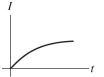
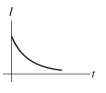
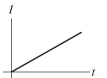
A charged capacitor is connected in series with a resistor and an open switch. At time t = 0 s, the switch is closed. Which of the graphs below best describes the current I through the resistor as a function of time t?


A)
A charged capacitor is connected in series with a resistor and an open switch. At time t = 0 s, the switch is closed. Which of the graphs below best describes the current I through the resistor as a function of time t?  A)    B)    C)    D)    E)
B)
A charged capacitor is connected in series with a resistor and an open switch. At time t = 0 s, the switch is closed. Which of the graphs below best describes the current I through the resistor as a function of time t?  A)    B)    C)    D)    E)
C)
A charged capacitor is connected in series with a resistor and an open switch. At time t = 0 s, the switch is closed. Which of the graphs below best describes the current I through the resistor as a function of time t?  A)    B)    C)    D)    E)
D)
A charged capacitor is connected in series with a resistor and an open switch. At time t = 0 s, the switch is closed. Which of the graphs below best describes the current I through the resistor as a function of time t?  A)    B)    C)    D)    E)
E)
A charged capacitor is connected in series with a resistor and an open switch. At time t = 0 s, the switch is closed. Which of the graphs below best describes the current I through the resistor as a function of time t?  A)    B)    C)    D)    E)

F) B) and C)
G) A) and E)

Correct Answer

verifed

verified

What is the magnitude of the potential difference between points A and C for the circuit shown in the figure? The battery is ideal, and all the numbers are accurate to two significant figures. What is the magnitude of the potential difference between points A and C for the circuit shown in the figure? The battery is ideal, and all the numbers are accurate to two significant figures.   A)  6.0 V B)  4.0 V C)  3.0 V D)  2.0 V


A) 6.0 V
B) 4.0 V
C) 3.0 V
D) 2.0 V

E) B) and D)
F) All of the above

Correct Answer

verifed

verified

A combination of a 2.0-Ω resistor in series with 4.0-Ω resistor is connected in parallel with a 3.0-Ω resistor. What is the equivalent resistance of this system?


A) 2.0 Ω
B) 3.0 Ω
C) 4.0 Ω
D) 9.0 Ω

E) B) and C)
F) C) and D)

Correct Answer

verifed

verified

Showing 1 - 20 of 157

Related Exams

Show Answer