A) rises, and interest rates rise.
B) rises, and interest rates fall.
C) falls, and interest rates rise.
D) falls, and interest rates fall.
F) A) and C)
Correct Answer

verified
Correct Answer
verified
A) has a slope that is explained in the same way as the slope of the demand curve for a particular product.
B) is vertical in the long run.
C) shows an inverse relation between the price level and the quantity of all goods and services demanded.
D) All of the above are correct.
F) A) and C)
Correct Answer
verified
Correct Answer
verified
A) real GDP will rise and the price level might rise, fall, or stay the same.
B) real GDP will fall and the price level might rise, fall, or stay the same.
C) the price level will rise, and real GDP might rise, fall, or stay the same.
D) the price level will fall, and real GDP might rise, fall, or stay the same.
F) A) and B)
Correct Answer
verified
Correct Answer
verified
Correct Answer
verified
Examples and variations on examples) in ...View Answer
Correct Answer
verified
View Answer
A) money is a veil.
B) real GDP measures the total quantity of goods and services produced by all firms in all markets.
C) the prices of some goods and services adjust sluggishly in response to changing economic conditions.
D) a lower price level increases real wealth, which stimulates spending by consumers and vice-versa.
F) A) and B)
Correct Answer
verified
Correct Answer
verified
A) quantity of labor and other inputs that firms want to buy at each price level.
B) quantity of labor and other inputs that firms want to buy at each inflation rate.
C) quantity of domestically produced goods and services that households want to buy at each price level.
D) quantity of domestically produced goods and services that households, firms, the government, and customers abroad want to buy at each price level.
F) A) and C)
Correct Answer
verified
Correct Answer
verified
B) False
Correct Answer
verified
Correct Answer
verified
A) both the price level and real GDP rise.
B) both the price level and real GDP fall.
C) the price level rises and real GDP falls.
D) the price level falls and real GDP rises.
F) B) and C)
Correct Answer
verified
Correct Answer
verified
A) an increase in taxes
B) an increase in government expenditures
C) a decrease in the minimum wage
D) an increase in the capital stock
F) A) and D)
Correct Answer
verified
Correct Answer
verified
A) the wealth effect and the interest-rate effect
B) the wealth effect but not the interest-rate effect
C) the interest-rate effect but not the wealth effect
D) neither the wealth-effect nor the interest rate effect
F) B) and D)
Correct Answer
verified
Correct Answer
verified
A) increase foreign bond purchases, so the supply of dollars in the market for foreign-currency exchange increases.
B) increase foreign bond purchases, so the supply of dollars in the market for foreign-currency exchange decreases.
C) decrease foreign bond purchases, so the supply of dollars in market for foreign-currency exchange increases.
D) decrease foreign bond purchases, so the supply of dollars in the market for foreign-currency exchange decreases.
F) A) and D)
Correct Answer
verified
Correct Answer
verified
A) taxes rise and shifts left if the money supply increases.
B) taxes rise and shifts right if the money supply increases.
C) taxes fall and shifts left if the money supply increases.
D) taxes fall and shifts right if the money supply increases.
F) A) and C)
Correct Answer
verified
Correct Answer
verified
A) 6%
B) 8%
C) 10%
D) 12%
F) All of the above
Correct Answer
verified
Correct Answer
verified
A) U.S. goods become more expensive relative to foreign goods so aggregate demand shifts right.
B) U.S. goods become less expensive relative to foreign goods so aggregate demand shifts right.
C) U.S. goods become more expensive relative to foreign goods so aggregate demand shifts left.
D) U.S. goods become less expensive relative to foreign goods so aggregate demand shifts left.
F) All of the above
Correct Answer
verified
Correct Answer
verified
A) an increase in the actual price level
B) an increase in the expected price level
C) an increase in the capital stock
D) None of the above is correct.
F) All of the above
Correct Answer
verified
Correct Answer
verified
A) the price of oil.
B) the rate of inflation.
C) the nominal interest rate.
D) the GDP deflator.
F) All of the above
Correct Answer
verified
Correct Answer
verified
Correct Answer
verified
The short run and lo...View Answer
Correct Answer
verified
View Answer
A) 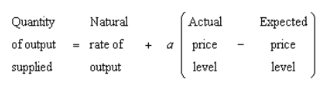
B) 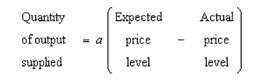
C) 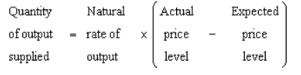
D) 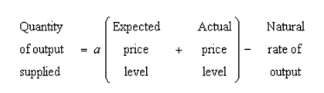
F) A) and C)
Correct Answer
verified
Correct Answer
verified
A) both a decrease in the price level and the implementation of an investment tax credit
B) a decrease in the price level but not the implementation of an investment tax credit
C) the implementation of an investment tax credit but not a decrease in the price level
D) neither a decrease in the price level nor the implementation of an investment tax credit
F) All of the above
Correct Answer
verified
Correct Answer
verified
A) aggregate demand shifted right
B) aggregate demand shifted left
C) aggregate supply shifted right
D) aggregate supply shifted left
F) All of the above
Correct Answer
verified
Correct Answer
verified
Showing 361 - 380 of 563
Related Exams