A) dry cleaners
B) farms
C) rocks that have been mineralized by natural processes but not mined
D) houses
E) all of these are possible sources of contamination
G) A) and C)
Correct Answer

verified
Correct Answer
verified
A) because the water flows faster and faster
B) because of diffusion of the contamination and mixing of contaminated and uncontaminated water
C) it does not spread out away from the source
D) it will only spread out if it is close to a cone of depression
F) A) and C)
Correct Answer
verified
Correct Answer
verified
A) well A
B) well B
C) well C
D) well D
E) well E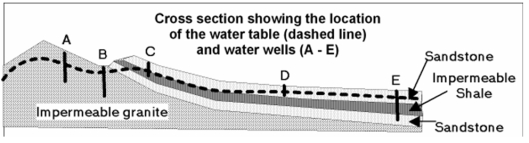
G) All of the above
Correct Answer
verified
Correct Answer
verified
A) industry
B) irrigation
C) drinking water
D) swimming pools
F) B) and C)
Correct Answer
verified
Correct Answer
verified
A) In most sediments,adjacent grains fit tightly together.
B) Fractures are the main way groundwater moves through some rocks,such as granite.
C) Most groundwater occurs in caves and underground lakes.
D) None of these.
F) A) and C)
Correct Answer
verified
Correct Answer
verified
A) controls the amount of water that can be stored
B) determines the composition of the cement between grains and clasts
C) does not depend on the size and shape of grains and clasts
D) is constant from one type of material to another
F) A) and C)
Correct Answer
verified
Correct Answer
verified
A) 1,2,and 3
B) 1 and 3
C) 2 and 4
D) 2 only
E) 4 only
G) B) and D)
Correct Answer
verified
Correct Answer
verified
A) seawater that is drawn into mid-ocean ridges,heated,and rises to the surface
B) water that is heated by magma and rises in hot springs
C) the rising and falling of tides in a cyclical manner
D) the way water is used to generate electrical energy
E) none of these
G) A) and E)
Correct Answer
verified
Correct Answer
verified
A) in most sediments,adjacent grains fit tightly together
B) fractures are the main way groundwater moves through some rocks,such as granite
C) most groundwater occurs in underground lakes
D) most groundwater occurs in underground rivers
E) all of these
G) C) and E)
Correct Answer
verified
Correct Answer
verified
A) highly fractured granite
B) compacted clay with abundant tiny pore spaces
C) loosely cemented,well-sorted sediment
D) loosely cemented,well-rounded sand grains
F) All of the above
Correct Answer
verified
Correct Answer
verified
A) unfractured granite
B) well-sorted gravel
C) compacted clay
D) uncompacted clay
E) poorly sorted sand,silt,and clay
G) A) and C)
Correct Answer
verified
Correct Answer
verified
A) inflation of the aquifer due to an increase in porosity
B) flooding due to rising groundwater levels
C) along the coast,pulling saltwater into wells that were previously fresh
D) all of these
F) A) and D)
Correct Answer
verified
Correct Answer
verified
A) 1 and 2
B) 2 and 3
C) 3 and 4
D) 1 and 4
E) none of these
G) C) and E)
Correct Answer
verified
Correct Answer
verified
A) a small explosion of methane gas from coal beds
B) a small explosion of CO2 gas from dissolving limestone
C) a rising dome of salt finally reaches the surface
D) the roof of a cave collapses
F) A) and B)
Correct Answer
verified
Correct Answer
verified
A) local climate and humidity
B) depth to the water table
C) presence of wells
D) the slope (gradient) of the water table
F) A) and C)
Correct Answer
verified
Correct Answer
verified
A) it feeds springs for the largest trout farms in the world
B) it is an important source of irrigation
C) it is an important source of coal and hydroelectric power
D) radioactive waste has been buried along the eastern side and is leaking
F) A) and C)
Correct Answer
verified
Correct Answer
verified
A) travertine
B) stalagmite
C) stalactite
D) sinkhole
E) flowstone
G) B) and C)
Correct Answer
verified
Correct Answer
verified
A) well-sorted sandstone
B) gray limestone
C) dark porous lava flows
D) gray granite
E) slate
G) A) and B)
Correct Answer
verified
Correct Answer
verified
A) drinking water and showering
B) mining and raising livestock
C) irrigation and drinking water
D) mining and industrial use
E) thermoelectric power and irrigation
G) A) and C)
Correct Answer
verified
Correct Answer
verified
A) seal fractures with clays and other minerals
B) fill pores between grains with clays and other fine-grained materials
C) fill pores with natural cement
D) all of these
E) none of these
G) All of the above
Correct Answer
verified
Correct Answer
verified
Showing 81 - 100 of 129
Related Exams